Category Archives: Uncategorized

mygov.org and the looming threat of democracy

Thought I’d venture into a bit of politics today. The channels of communication and social media that are opening around us, like flowers in spring, invite us to reconsider the role of the individual citizen in decision-making processes, at least in democratic countries. Are we not on the cusp of a transforming technology that allows—not just public debate orchestrated by main stream media—but the possibility of real input by ordinary people in the major policy decisions of our various levels of government?

Please join me today for a short thought experiment. Imagine a government website called mygov.org, where you may navigate to either Federal, State or Municipal government levels. Let’s suppose that we head for the State level. There we find:

  1. An overview of the structure of the State government—who are our representatives, what are the major departments, who is in charge of what, contact information and links etc.
  2. A summary of the current State Budget, together with summaries of previous budgets and a range of charts showing budget allocations in graphical form over various ranges of years. The citizen (you or I or our next door neighbour) can get a sense for where the State government gets its money (mostly from us of course!) and what it is spending it on. In particular a summary of the current levels of debt are prominently visible.
  3. A record of our politicians’ debates in the various houses of government, a current listing of bills being proposed, and written statements from elected representatives as well as public experts on issues of current policy.
  4. And of greatest interest! The VOTING BOOTH: an electronic portal that allows voting citizens (via a user name and password) input into the issues of the day. For example: Should we decrease the cost of the Airport train link to encourage tourists to use it, keep it as it is, or hike it to make more money? On this issue we can read pros and cons from various groups which have some expertise or direct involvement, as well as summaries from politicians and civil servants that have an opinion. There are threads of comments for public debate. Costings of the various alternatives from Treasury are there, as well as a legal analysis, if relevant. And at the bottom, you have a chance to vote: by using (say) one to three of your 10 yearly STATE VOTING COUPONS. If this issue is one that you feel strongly about, you can assign some weighted allocation of votes to the issue, and all our votes are combined to determine a public response to the topic.

Obviously this last point needs some mathematical and sociological expertise to set up, and tinkering no doubt will be needed to get it working well. During the first years of this tentative real-time democracy, perhaps the government would be legally obliged to follow the electorate if a 75% majority was in one direction or another, but only encouraged to follow us if the range was 50%-75%. The role of politicians would move subtly towards framing questions and providing balanced and detailed (!) views of the different sides to issues, persuading us by providing facts and careful reasoning, not just cliches and wishful thinkings.

But are we, the rabble, sensible and intelligent enough to hold some of the reins of power?  Are we really interested and willing? My guess to both of these questions is a tentative yes. We would want to ensure some checks and balances.

And what about all those entrenched and vested interests? That’s also a question.

The economic value of being different

Ever wonder if it might just be advantageous to think differently from those around you? Sure there are lots of cons: maybe you tend to get bored by what you consider inane talk about mindless sporting events, celebrity gossip or international news. While everybody else dreams of four bedroom mansions with fully chrome kitchen appliances and expensive German cars parked out in the driveway, perhaps your thoughts are on growing cacti, or brushing up on 19th century Russian literature, or whether RomeoVoid might ever come out with a new album?

Well, the good news is: being different is actually economically good for you! I propose to expound this (novel??) theory here in this blog: the Nobel prize jury for economics knows where to find me, and I am fully prepared to wait a few years.

Let’s explain the basic idea with a simple model. In the Land of Pi, people like to eat apples and bananas. For various reasons ostensibly connected with supply and demand, bananas are more expensive than apples: in fact one banana costs the same as four apples. Everywhere in the land of Pi, where the citizens are placidly uniform and all more or less think the same pleasant thoughts, everyone agrees that  B=4A.

Want to trade your two bananas for my eight apples? Sure, that’s only fair. But your two bananas for my nine apples? You’ve got to be kidding! I know the true value of things.

In the far distant Land of E however, where apples and bananas are also the two main fruits, a different agricultural rhythm prevails. Perhaps the place is more tropical, and bananas grow more easily, or perhaps the United Apple Consortium has better political and marketting savvy: in any case apples and bananas in this land have equal value: one apple and one banana are worth more or less the same. Young people, old people, rich or poor all realize that  B=A is the state of affairs here.

Now let’s suppose that you, a happy citizen of the Land of Pi, take a long and perilous journey to the Land of E. The Lands are far apart, so essentially no trade takes place between them–a fact that we can deduce from the marked differentials between the values of apples and bananas. You’ve scraped up some Land of E money doing some casual labour, and head off to the store to buy food.

You are going to be in for a bit of a surprise in the fruit section. Instead of bananas being four times as expensive as apples, which all reasonable people know to be the true value, here they are actually equal in price! Let’s make the assumption that for an hours worth of work, you can get roughly the same amount of food as you can in Pi. It means that bananas are much cheaper here than you are used to, while apples are more expensive. Naturally you are going to buy lots of bananas, and you are going to think—this is great, I am getting a lot more food for my hour of labour here! Of course you might get a hankering for apples now and then, but every time you buy one the exorbitant price will annoy you.

Of course this example involves two products that are more or less interchangeable as a food source—you don’t actually need to buy both of them. There are no doubt other qualifications to add before undergrads starting learning Wildberger’s Theory of Relative Values. The Nobel committee will want me to quantify the theory, but I think the basic idea doesn’t really need much mathematical underpinning. If you have a different value system from those around you, some things appear cheaper to you while others are more expensive, so if you can choose you are better off.

Here is a way of turning the situation around to see the argument in a different light: suppose someone opened a new store where all the prices were as usual in the first week, but then in the second week they were all marked up or down in a random fashion. When would you prefer to go shopping? If you didn’t actually have to buy any one particular item, I bet you’d go during the second week.

Here is another example: here in Australia at the beginning of the twenty-first century, I can go to a movie for $10, a play for $50, a symphony concert for $60, an opera for $200, or a Barbra Streisand show for $1200. My estimations of the “true value” of these things? Something like: movie $15, play $30, concert $20, opera $50, and Barbra’s show I won’t say, in case you are a fan.

You can deduce that I rarely see plays, go to concerts, attend operas or pay money to hear famous people sing. Because I am a cultural slob? No, simply because they are worth a lot less to me than the market wants. Movies, on the other hand, are worth more to me than I can get them for. Naturally I see lots of movies, and am happy.

So an interesting psychological ploy now manifests itself. Instead of working harder to make more money to spend on stuff, why don’t you just judiciously re-orient your thinking so that you value things differently than the market? The direction of re-orientation is not really important, the main principle is that the more widely your value lists differ from those of the majority, the better off you are in real terms. Non-conformity is the new economic black!

Suppose that I could hypnotise myself into thinking that movies are much more interesting and worthwhile than I think they already are—each experience worth hundreds of dollars: say on a par with a helicopter ride over the Grand Canyon, or those early morning balloon flights over the Hunter Valley Vineyards. Wouldn’t I be a lucky chap then, managing to snare such bargains for the ridiculously low price of $10 a shot! You get the idea; I’d end up with thousands of dollars of value each month for next to nothing.

On a related note, I would be interested in knowing what people think about how much things are “really worth”.  How much are different kinds of cars worth? How much are holidays to various places worth? How much are dates with different types of women worth? How much is early retirement worth? (One of these questions seems a lot more interesting than the others, don’t you think??)

And of course, how much are apples and bananas really worth?

Are mathematicians scientists?

I’ve just come back from a few weeks in Thailand, where I gave talks at Chulalongkorn University, Thammasat University and Chiang Mai University. I also attended a conference on Geometry and Graphics in Bangkok, and met my mathematician friend Paolo Bertozzini, who is always a pleasure to talk to, full of insights and anecdotes from his long experience in the Land of Smiles. By the way, Thailand is a fascinating and wonderful place, visit if you can!

Travelling gives me time to muse; I can’t always be at the computer (even though on this particular trip I did spend a lot of time working on two papers with my graduate students) and waiting for airplanes or sitting in them gives one time to speculate. A topic that I have been pondering is: to what extent are mathematicians scientists? Or are we actually something else?

Probably I am steering towards the something else. Sure, mathematics and science have a lot in common. Science uses lots of maths first of all in setting up its theories. This used to be much more true of the physical sciences, but increasingly the biological sciences are also becoming more mathematical–or at least some aspects of them are. And some applied mathematicians are pretty close to being physicists, but not really experimental ones. I believe a strong case could be made that most mathematicians do research like scientists: we observe patterns, try to formulate theories to explain them, and then subject those theories to experiments–in our case calculations–to discover that they are probably wrong and need to be modified.

But in my experience this somewhat standard view-point misses an important distinction that needs a historical perspective to appreciate. Mathematics has been around a lot longer than science. The Greeks were doing mathematics at a very high level more than two thousand years ago. Mathematicians have a long sense of history, humbled and awed by the great minds which have preceeded us, of accomplishments in centuries gone by which we can no longer hope to surpass, or even equal.

The scientist thinks, and feels, quite differently. Science really only kicked off about 500 years ago in Europe, when people slowly started thinking thoughts like: how do we really know when something is true? Can belief and truth be separated? Does our desire that the world be a certain way prevent us from seeing it as it really is?

I remind you of the answers to these kinds of questions that people came slowly to appreciate: that the source of all true knowledge is observation: careful, unbiased and thorough. From the observations we make, we formulate theories to explain them. The simplest and most powerful theories take precedence. Finally we examine the implications and predictions of our theories and see if these are born out. If so, we strengthen our faith in our theories but do not become dogmatic about them. We are prepared to be wrong, and to change our minds when confronted with new evidence and explanations.

How much deep knowledge and power resides in the understanding which I have crudely summarized in the previous paragraph! A whole brave new way of thinking, of seeing, of understanding the world. Brave, because we are prepared to face the music, however it may sound. No longer must the heavens dance to a tune of our liking. Maybe we are small, and insignificant, and weak. But we will have the courage to admit it, and to carry on none-the-less in understanding the world, unconcerned if we are no longer at the center of God’s great plan, should such a One exist. And we are not upset if our theories overturn and disprove the thoughts of a previous generation–in fact we welcome such, and strive towards the breakthrough that upturns the applecart.

I believe that modern mathematics has lost its way logically, and that a new and far more interesting mathematics awaits us. I have a fair amount of evidence to support this point of view. Rational trigonometry gives a much simpler and more powerful approach to trigonometry and geometry, making computations easier—but the kicker is that it actually makes logical sense, as opposed to classical trigonometry, the development of which is a logical basketcase! And Universal hyperbolic geometry is likewise a complete logical overhaul of hyperbolic geometry, again replacing pictures and wishful thinkings with simpler and much more careful reasonings. Both of these new developments result in many novel and beautiful theorems.

It has been interesting, and I will admit somewhat (but not overly) disappointing, to see how uninterested my fellow pure mathematicians are in contemplating really new directions of thinking, and how unsure they are in applying their own critical analysis to weigh the evidence, rather than rely on authority and precedence.

The force of habit in people’s thinking weighs heavily on them, the mark of a heavy and bloated subject. How can I inject more scientific thinking amongst my fellow pure mathematicians? How can I make the subject lighter? These are the kinds of thoughts I have been thinking in Thailand.

Difficulties with real numbers

This is an important topic on which I will have a lot to say. Today, let’s just gently introduce a big stumbling block for modern analysis.

There are several approaches to the current theory of “real numbers”. Unfortunately, none of them makes sense. One hundred years ago, there was vigorous discussion about the difficulties, ambiguities and even paradoxes. The topic was intimately linked with Cantor’s theory of “infinite sets”.

As time went by, the debate subsided, but the difficulties didn’t really go away. A largely unquestioning uniformity has settled on the mathematics community, with most students now only dimly aware of the logical problems with “uncomputable numbers”, “non-measurable functions”, the “Axiom of choice”, hierarchies of “cardinals and ordinals”, and various anomalies and paradoxes that supposedly arise in topology, set theory and measure theory.

A hundred years ago, the notion of the “continuum” appeared intuitively straightforward, but it was difficult to pin down precisely. The Greeks had struggled with irrational numbers, but the decimal number approach of Simon Stevin in the 16th century seemed reasonable, especially considering that in practice the further digits beyond the three dots in pi=3.14159263… are hardly of practical significance. Great mathematicians like Newton, Euler, Gauss, Lagrange and others were always interested in a combination of applied questions (physics and astronomy mostly) along with more theoretical questions. In the later part of the nineteenth century an increasing preoccupation with trying to pin down the fundamentals of analysis led to both more careful definitions but also to the realization that the default view of irrational numbers as infinite decimals was shaky.

However with the advent of relativity theory and quantum mechanics, the concept of the continuum again became murky: if time is relative and perhaps finite in extent, and space has an inherent graininess which is not infinitely divisible, then what exactly are we modelling with our notion of the `infinite number line’?
While engineers and scientists viewed real numbers primarily as “decimals which go on till we don’t care anymore”, nineteenth century mathematicians introduced the ideas of  “equivalence classes of Cauchy sequences of rational numbers”, or as “Dedekind cuts”, or sometimes as “continued fractions”. Each view has different difficulties, but always there is the crucial problem of discussing `infinite objects’ without sufficient regard to how to specify them.

The twentieth century saw an entirely new sleight-of-hand; the introduction of “axiomatics” removed the time-honoured obligation of defining mathematical objects before using them. This was a particularly unfortunate and wrong-headed turn of events that has done much to diminish the respect for rigour in modern mathematics.

A finite sequence such as S=1,1,2,5,14,42,132,429,1430 may be described in many different ways, but ultimately there is only one way to specify such a sequence S completely and unambiguously: by explicitly listing all its elements.

When we make the jump to infinite sequences, such as the sequence of Catalan  numbers C=1,1,2,5,14,42,132,429,1430… (sequence A000108 in Sloane’s Online Encyclopedia of Integer Sequences (OEIS) at http://oeis.org/ ) the situation changes dramatically. It is never possible to explicitly list “all” the elements of such a “sequence”; indeed it is not clear what the word “all” even means, and in fact it is not clear even what the term “infinite sequence” precisely means. (Do you think you have a good definition?)

But assuming for a moment that we have some idea of the terms involved: still we are obliged to admit that in the absence of a complete list of the elements, we can specify the Catalan sequence C essentially only by giving a rule which generates it. A quick look at Sloane’s entry for the Catalan numbers shows some obvious problems: which of the potentially many rules that generate the Catalan numbers are we going to use? How are we going to tell when one rule actually agrees with a seemingly quite different one? Is there some kind of theory of `rules’ that we can apply to give meaning to the generators of a sequence?

If we think in terms of computation, an infinite sequence can also be modelled by a computer program, churning out number after number onto a long tape (or these days your hard drive). At any given point in time, there are only finite many outputs. As long as you keep supplying more tape, electricity, and occasionally additional memory banks, the process continues. The sequence is not to be identified by the `completed output tape’, which is a figment of our imagination, but rather by the computer program that generates it, which is concrete and completely specifiable. However here we come to the same  essential difficulty with infinite processes: the program that generates a given infinite sequence is never unique. There is no escape from this inescapable fact, and it colours all meaningful aspects of dealing with `infinity’. It seems that any proper theory of real numbers presupposes some kind of prior theory of algorithms; what they are, how to specify them, how to tell when two of them are the same.

Unfortunately there is no such theory.

With sets the dichotomy between finite and `infinite’ is much more severe than for sequences, because we do not allow a steady exhibition of the elements through time. It is impossible to exhibit all of the elements of an `infinite set’ at once, so the notion is an ideal one that more properly belongs to philosophy—it can only be approximated within mathematics. The notion of a `completed infinite set’ is contrary to classical thinking; since we can’t actually collect together more than a finite number of elements as a completed totality, why pretend that we can? It is the same reason that `God’ or `the hereafter’ are not generally recognized as proper scientific entities. Both infinite sets, God and the hereafter may very well exist in our universe, but this is a philosophical or religious inquiry, not a mathematical or scientific one.

The idea of `infinity’ as an unattainable ideal that can only be approached by an endless sequence of better and better finite approximations is both humble and ancient, and one I would strongly advocate to those wishing to understand mathematics more deeply. This is the position that Archimedes, Newton, Euler and Gauss would have taken, and it is a view that ought to be seriously reconsidered.

Why is any of this important? The real numbers are where Cantor’s hierarchies of infinities begins, and much of modern set theory rests, so this is an issue with widespread consequences, even within algebra and combinatorics. Secondly the real numbers are the arena where calculus and analysis is developed, so difficulties lead to weakness in the calculus curriculum, confusion with aspects of measure theory, functional analysis and other advanced subjects, and are obstacles in our attempts to understand physics. In my opinion, we need to understand mathematics in the right way before we will be able to unlock the deepest secrets of the universe.

By reorganizing our subject to be more careful and logical, and by removing dubious `axiomatic assumptions’ and unnecessary philosophizing about `infinite sets’, we make it easier for young people to learn, appreciate and contribute. This also strengthens the relationship between mathematics and computing. It is time to acknowledge the orthodoxy that silently frames our discipline. We need to learn from our colleagues in physics and computer science, and begin the slow, challenging but ultimately rewarding task of restructuring mathematics properly.


My boring seminar talks

Perhaps, some day, you will attend one of my research seminars! I give these now and then, to let my colleagues here at UNSW, or at conferences, know the results of my latest exciting mathematical researches and breakthroughs. Over the years I have talked about group representations, Lie theory, hypergroups, special functions, number theory, combinatorics, and mathematical physics, but these days it is usually some aspect of geometry or rational trigonometry—whatever I have been working hard at for the last year or so.

Having given such talks dozens of times over the past few decades, I am now just starting to suspect, somewhat painfully, that most of them have probably been quite boring. Not to me of course!—I find them singularly interesting, especially when full of the adrenalin that talking for an hour in front of a room full (or half full, or one quarter full) of highly intelligent people gives you.

What made me suspicious? Nothing obvious, just a few subtle tell-tale signs, a hint here or there. People sleeping during the lecture. Audible snores. Some colleagues deeply engaged in test marking, others seeming to meditate quietly with their eyes closed, yet others studying the cloud formations out the window. The drooping eyelids followed by the dropping head, and then the automatic jerk as the body regains consciousness before hitting the desk. The awkward silence at question time, the nominal polite question from the seminar organizer or a friend in the audience.

So because one shouldn’t jump to conclusions quickly, I now make discreet observations of members of the audience at other pure mathematics seminars. And I am pleased to report that with some key exceptions, the phenomenon seems to be almost universal. Not only are my seminars boring, but in fact most pure mathematical seminars are boring—judging solely by the audience attention and reaction.

This is surely a conundrum, seeing as pure mathematics has to be one of the most fascinating areas of human endeavour! How can we explain it?

To answer this question, I have submitted myself to intense psychological self-examination in the interests of Science. The results are not pretty, and don’t cast me and my fellows in a glowing light. This is reality journalism, self-confession and science reporting, all rolled into one.

The need to impress When I give a lecture to my professional colleagues, I pretend I am interested in informing and entertaining them. In reality my motives are much more nefarious and self-centered: I want to convince them that I have not been twiddling my thumbs for the last year, that I deserve to get more research money, that I ought to be promoted, and that I am generally not the moron I appear to myself most of the time. To do this is no easy task, but I have a well-trodden path to follow.

The key is to make my talk as technical and difficult to understand as possible. If the listeners can’t absorb and follow my seminar, they won’t suspect it is mostly uninteresting, and ultimately rather trivial (the key result boils down to setting a derivative to zero, or solving a quadratic equation, or something equally mundane). I formulate the most general version of everything, give the most specialized and convoluted examples, and make sure that the theory gets dressed up as something much more subtle and difficult than it really is.

Keep expository stuff down to a minimum Since most of my colleagues aren’t familiar at all with the particular areas I investigate, they would probably benefit most by an entertaining, expository, and wide ranging overview of the area. They would like to see the gems in the subject, the really beautiful arguments, the most important and useful results, the surprising connections with adjacent disciplines. But giving them what they want would be like dousing water on my all-important reputation. Most of the really interesting things in my area have been established long ago, perhaps by Euler, Sophus Lie, Felix Klein or Hermann Weyl. How is explaining their lovely insights going to enhance my reputation, increase my prospects for promotion, or improve my chances of getting one of those obscenely rich Australian Research Council grants?

Rising up in the cult of complexity Modern pure mathematics gets a bit insular, and so it becomes really challenging to compare the relative importance of different people’s work. Is my theory of Modular cuspidal cohomology of the functorial duals of p-adic proto-sheafs on a transcendental delta ring more interesting than your theory of Simplicial foliations of the pseudo-twisted maximal operator on the spinor bundle of a perverse quantum monoid? Who’s to say?

What ultimately counts is what we can get our colleagues to believe about the depth and importance of our research fumblings, how many papers in prestigious (i.e. unreadable) journals we publish, and how big and influential our circle of citation/conference-buddies becomes. This is a zero-sum game, my friend, and  the complexity and incomprehensibility of my seminars is a key tool to impress the Dickens out of you and my colleagues. Academic self-interest must prevail, and so I am happy to say that my next seminar will be…deep, profound and extremely important! In other words, boring.

Logical difficulties in modern mathematics

Modern mathematics is enormously complicated and sophisticated. It takes some courage, and perhaps some foolishness, to dare to suggest that behind the fancy theories lie serious logical gaps, and indeed error. But this is the unfortunate reality. Around the corner, however, is a new and more beautiful mathematics, a more honest mathematics, in which everything makes complete sense! It is my job to give people glimpses of this better, more logical alternative, and to empower young people especially to not be afraid to question the status-quo and the dubious thinking that currently holds sway over the subject. My MathFoundations series of videos will investigate these problems in a systematic way; let me here at least briefly outline some of the problems, so you can get an initial idea, and so that perhaps some of you will start to think more seriously about these important issues. I will be saying a lot more about these topics in future posts.

The notion of rigour in mathematics is a difficult one to pin down. Certain historical periods accepted notions or arguments that later were deemed insufficiently precise, or even incorrect, but this often became clearer only once a more accurate way of thinking emerged. A familiar illustration is the geometry of Euclid’s Elements, which for most of the last two thousand years was considered the model for logical presentation of mathematics. Only in the nineteenth century did it become acknowledged that Euclid’s definitions of point and line were imprecise, that he implicitly used rigid motions for proofs without defining them, that intersections of circles were taken for granted, that notions of betweenness were used without being supported by corresponding definitions, that arguments by pictures were implicitly used, and that most of the three-dimensional parts of the geometry were logically unsubstantiated. In each of these cases it became possible to talk about alternative ways of thinking, due to non-Euclidean geometries, linear algebra, and the idea of geometry over finite fields. Einstein’s theory no doubt played a big role in loosening people’s conviction that Euclidean geometry was somehow God-given.

The foundations of trigonometry are also suspect as soon as one inquires carefully into the nature of an angle—a difficult concept that Euclid purposefully avoided. It requires either the notion of arc-length or area contained by a curve, and both of these require calculus. The usual pastiche of trigonometric relations depend logically on a prior theory of analysis; a point that even most undergraduates never really properly see. Indeed the very notion of a curve was problematic for seventeenth and eighteenth century mathematicians, and even to this day it is not straightforward. For example, one of the supposedly basic results about curves is the Jordan curve theorem: a simple closed curve in the plane separates the plane into two regions; but it is the rare undergraduate who can even state this result correctly, least of all prove it.

There are even surprising and serious logical gaps with first year calculus. The foundations of the “real number line” are notoriously weak, with continued confusions as to the nature of the basic objects and the operations on them. Attempts at trying to define “real numbers” in the way applied mathematicians and physicists would prefer—as decimal expansions—run into the serious problems of how to define the basic operations, and prove the usual laws or arithmetic. [Try to define multiplication between two infinite decimals, and then prove that this law is associative!] The approaches using equivalence classes of Cauchy sequences, or Dedekind cuts, suffer from an inability to identify when two “real numbers” are the same, and purposefully side-step the crucial issue of how we actually specify these objects in practice. Dedekind cuts in particular are virtually picking oneself up with one’s own boot straps, with a notable poverty of examples. The continued fractions approach, while in many ways the most enlightened path, suffers also from difficulties. The result of these ambiguities is a kind of fantasy arithmetic of real numbers, a thought-experiment floating above and beyond the reach of concrete examples and computations. Which is why the computer scientists have such a headache trying to encode these “real numbers” and their arithmetic on our computers.

The serious problems with the continuum are reflected by an attendant state of denial by our first year Calculus texts, which try to bluff their way through these difficulties by either pretending that the foundations have been laid out properly elsewhere, can be replaced by some suitable belief system dressed up using “axiomatics”, or can be glossed over by appeals to authority. The lack of examples and illustrative computations is illuminating. A challenge to those pure mathematicians who object to these claims: can you show us some explicit first year examples of arithmetic with real numbers??

The Fundamental Theorem of Algebra, a key result in undergraduate mathematics, that a polynomial of degree n has a zero in the complex plane, is almost never proved properly. While it ostensibly appears to be `proved’ in complex analysis courses, it is doubtful that this is convincing to students: after all, by the time one has studied complex analytic functions to the point of being able to apply Liouville’s theorem, who can say for sure whether one has not already used the very result one is ostensibly proving, perhaps implicitly? In fact complex analysis as laid out in undergraduate courses is very much open to criticism, and not just because of the nebulous situation with `real numbers’. Yet this crucial result (FTA) is used all the time to simplify arguments.

Closely connected with all of this is Cantor’s theory of `infinite sets’ and its current acceptance by the majority as the foundation of mathematics. The essential problem that ultimately overwhelmed Cantor is still with us: what exactly is an “infinite set”? For a long time now it has been well-known that Cantor’s initial “definition” of an infinite set was far too vague; consideration of the “set of all sets”, or the “set of all groups” or the “set of all topological spaces” are fraught with difficulty and indeed paradox. The modern attitude is to slyly substitute some other terms like “class” or “family” or “category” when possible contradictions might arise. Hopefully fellow citizens will have the decency to not raise the question of what exactly these words mean! If everyone plays along, there is no problem, right?

Other weaknesses of modern analysis arise with issues of constructability and specification. What do we actually mean when we say “Let G be a Lie group”, or “Consider the space of all analytic functions on the circle” or “Now take the nth homology group”?? Terminology is important: I have never seen a proper discussion of what the words let, consider or take actually mean in pure mathematics, despite their universal usage. Difficulties with terminology also affect the core set-up: the modern mathematician likes to frame her subject in terms not only of sets but also of functions. The latter term is almost as problematic as the former.

What precisely is a “function”? Okay, the usual definition is something like “a rule that inputs one kind of object and outputs a possibly different kind of object”. But this passes the buck from defining the term “function” to defining the term “rule”. Are we thinking about a computer program here? If so, what kind of program? What language and syntax? What conventions about how to specify a program, and how does one tell if my program defines the same “function” as your program??

The modern analyst likes to go further, and also talk about “arbitrary functions”, allowing not only those that can be described in some concrete way by an arithmetical expression or a computer program, but also all those “functions which are not of this form”. What exactly this means, if anything, is highly debatable. The lack of clear examples that can be brought to bear on such a discussion is a hint that we are chatting here about something other than mathematics. Surely a distinction ought to be drawn between “functions” which one can concretely specify and “functions” which one can only talk about. Even better would be to cease discussion about the latter entirely, or at least relegate them to philosophy!

The theoretical use of limits in calculus is generally lax. This despite all the huffing and puffing with epsilons and deltas, whose seeming precision obscures the more devious sleights of hand, of which there are many. For example, while care is often used to `prove’ the Intermediate Value Theorem (which is obvious to any engineer or physicist), the use of `limit’ in the usual definition of the Riemann integral is almost a complete cheat. Have a look at your calculus book carefully in this section, and see what I mean! Most first year students are blissfully unaware of the vast logical gaps in their courses. Most mathematicians do not go out of their way to point these out.

Of course there is much more to be said about these issues. All of them will be addressed in my MathFoundations YouTube series, but I think it useful to also begin a discussion of them here in this blog. There is another, more beautiful, mathematics waiting to be discovered, but first before we can properly see it, we need to clean out the cobwebs that currently obstruct our vision.

The future of education: YouTube and iTunes U??

We live in interesting times; a good thing—so far at least. One of the momentous waves of change which is just now starting to roll over universities and academics around the world is a whole new online way of learning, accessible from essentially anywhere, for free. This will have a deep and profound effect on academic life. The Australian recently ran an article on this development, featuring my friend and colleague Chris Tisdell (Google: Tisdell, seismic shift, education to access the article). 

Increasingly you can log onto YouTube, or iTunes U, or other repositories, and start learning about anything you want. While in many areas the offerings are still in a scattered and embryonic form, the amount of material and resources is increasing exponentially, and the process seems clearly irreversible. More organized courses called MOOCS are using platforms such as Coursera, EdX, Udacity and others to train tens of thousands of students (how successfully is still a question). Other platforms are being established as you read this.

No amount of feet dragging by academics, textbook publishers, college administrators, and other entrenched interests will likely stop this trend. The reality is that universities as sole repositories of high-end knowledge and learning is coming to an end. Academics like myself will have to adapt or be prepared to go the way of the harness and carriage-makers a hundred years ago with the advent of the motor car. The lesson is clear: change, or be made irrelevant.

Right now, I have about four tutorials a week in first year Linear Algebra or Calculus. I find myself saying the same things as the lecturer in the next room, and that I have said dozens of times in the past. The same scenario is repeated with little variation in thousands of colleges around the world. This is an unsustainable situation, much as perhaps we would like it to continue, as our jobs largely depend on it.  The reality is that having thousands of essentially identical first year tutorials/classes around the world on, say, “the derivatives of inverse hyperbolic functions”, or “how to apply the normal distribution” is increasingly a situation approaching its use-by date. Clearly it is vastly more logical and practical for a few people to develop the lessons really well, and put them on YouTube for anyone, anywhere to watch whenever they feel like it. Once that happens, and students can access easily the information they need, thousands of academic jobs almost immediately become redundant.

The teaching role of universities, especially for large popular subjects, will inevitably change from providing primarily learning content to providing primarily assessment, support and certification. People will pay to get a certificate of achievement. They will no longer be so willing to pay to get instruction that they can easily get for free online. No doubt there is a social aspect of going to university; meeting other young people, playing cards or soccer during lunch hours, and chatting to your university lecturers. Attending a class can be a positive experience. But it can also be rather lukewarm: some college level lecturers are not stellar teachers, have ordinary communication skills and little real training in education. Once the choice between a mediocre live lecture and a high production video with powerful graphics and an entertaining dynamic expositor is available, I think we all know where most students will go. The core idea that universities and colleges primarily provide instruction, and rather high priced instruction at that, has to change.

Many of my academic colleagues will, quite understandably, be upset at this development. My own efforts at posting lots of mathematics videos online at YouTube (my channel is called Insights into Mathematics, user: njwildberger, check it out!), along with those of Chris Tisdell (his channel is called Understand Mathematics, user: DrChris Tisdell, check it out!) are seen by some of our colleagues as competitive with the traditional lecture format. But the reality is that the changes that are coming are made inevitable by the technology at hand; the question is only whether one is willing to embrace them and move forward on the train, or stand still like deer in the headlights. We see ourselves as potential bridges to the future: establishing UNSW as a key contributor in providing quality mathematics instruction to the world, along with more established and well-funded players like MIT, Stanford etc.

For centuries universities have been elite institutions catering to the sons of the rich to ready them for positions of power and privilege. In the twentieth century that scenario gradually expanded, allowing first women and then more and more middle class and even working class students into the college and university framework. While this has been a great contributor to the rise in equality in the Western world, still most of the rest of the world was excluded from the process, as the high-end educational institutions were concentrated in mostly well-to-do Western countries. The current technology supports a massive expansion of knowledge into the third world, as well as empowering ordinary people, young and old, rich or poor, to learn, learn, learn, as long as they want to! It will be one of the really big game-changers in the brave new world of tomorrow. Education is a killer application for the internet.

The modern lifestyle: supported by our children

Every so often my thoughts turn to the curious economic situation we have built for ourselves here in the Western world, over the last century or two. The greatest building and economic boom in history has been hurtling along for some time now, but there are some serious issues that are starting to become difficult to ignore, even though we might like to. Most of these revolve around a four letter word which is the cure to all evils to some, and the cause of all evils to others: debt.

Around two hundred years ago, governments in Denmark and Germany started raising money for building projects by issuing bonds: asking people for loans which would be paid back over a long time period (say 30 years); which paid a generous rate of interest; and which were backed by the buildings themselves. Since then, the bond market has blossomed into a huge industry with many variants, but the basic principle remains constant: the public/government borrows money from rich citizens to spend on needy projects, and promises to pay back, with interest, sometime in the future. The rich citizens win–they get a sure and safe return on their money, often with a better return than they could otherwise expect from other investments. The public wins: they get shiny new buildings, roads, airports, armies, hospitals or schools, and generous pensions for civil servants. The governments win: they get credit for providing essential services, a happy populace, and money to spend promoting re-election. It seems like a win-win situation: but are there really no losers?

Unfortunately, there often are. They are called children, grand-children, and great grand-children. Boiled down to its essentials, the basic equation is this: we borrow from our children to support a lifestyle we otherwise could not afford. The beauty in this arrangement, from the point of view of the generation making it, is that the approval, or even the awareness, of the future generations who will pay for it is not required! With the the modern financial, legal and government set-up, we are able to simply legislate monies into existence. This is a modern kind of financial sleight of hand, as if from the Ministry of Magic in Harry Potter world. Need an extra few billion dollars? Wave the legislative wand, and lo!, it is there.

In time, the borrowing inevitably starts to escalate: it is all too easy. We find ourselves always requiring more money, each time to cover not just our bigger and bolder plans, but also the interest charges of our previous loans, which grow more and more onerous. Once we get used to the idea of an inevitable “national debt”, we don’t resist when the politicians jack it up yet a little bit more—in our best interests, naturally.

After a while, successive generations become simultaneously victims and beneficiaries of the system, which comes more and more to resemble a Ponzi scheme (first-in get paid, last-in lose). Each new generation, as they become conscious of the state of affairs, looks backwards with annoyance at the previous cohort for having gotten them into the mess, and then looks ahead at ways of passing the buck to the next lot. Government debt getting into stratospheric levels? Let’s just sell off a bit more of the public domain; our roads, our power systems, our hospitals, our airports, our public lands. Still not enough cash to support all the lavish entitlements and retirement plans that we all so richly deserve? Borrow more money from our ever-more-wealthy wealthiest citizens, or perhaps the Asians, or just print some more.

With the baby boomer demographic bulge moving into retirement, and life expectancies still on the rise, many commentators are now starting to realize that the pressures on the current generation of young people to keep the system going is shortly going to become acute, perhaps even unmanageable without serious alterations to expectancies.

Governments are raising retirement ages, pension plans are, in many places, starting to look wobbly (my own UniSuper superannuation scheme here in Australia has started making rumblings about not enough cash to meet future committments), and while the mainstream media maintains their reluctance to acknowledge and assess the problem fairly, more and more discontent is registering in alternate forums on the internet. The prospect looms of future action by younger people to rein in the lavish retirement packages that the baby boomers have lined up for themselves. What legislation can give, legislation can take away.

In the university sector here in Australia, I joined a few years too late to enter the “old superannuation scheme”, which overly generously allows my older colleagues to have retired in their late fifties with essentially full salaries as pensions. My cohort will have to work well into their sixties to receive possibly only 1/2 to 2/3 of our salaries. Does this seem fair? Well not to me, but then again to an already-retired person it is probably quite acceptable. And future generations? What kind of weight will my daughter’s demographic group have to collectively bear? It’s a question.

Siberian recollections

My conferences in Novosibirsk and Baska (on the isle of Krk in Croatia) are over and I am in Zagreb for a couple of nights before my flight home. Novosibirsk is in the middle of Russia, the largest city in Siberia and third largest in Russia itself. It straddles the Ob river, one of the longest in the world, and was built largely to support the Trans-Siberian railway bridge built more than a century ago across the river.

Walk

A typical walk in the Academic town between Institutes

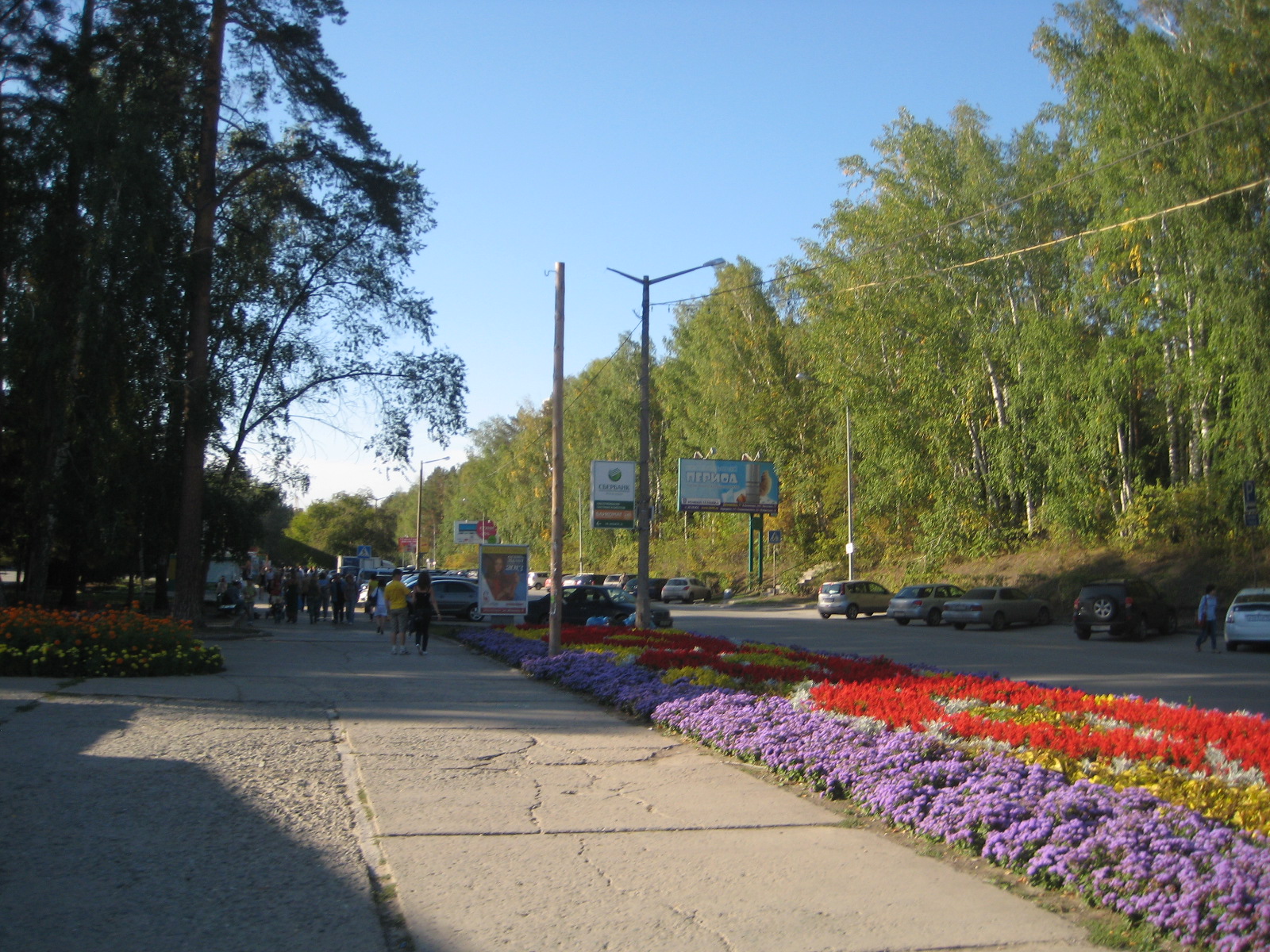
The Geometry conference was held in a satellite suburb called something like “Academic Town” in Russian: a sprawling complex of Scientific Institutes set in a forest, with pleasant walking paths through the birch and pines. The northern forest reminds me of Canada, and so I enjoyed the walks I took, several with my new young friend Maxim, a student of Alexander Mednykh, the mathematician who had invited me.

The Ob sea: man made reservoir outside Novosibirsk

Maxim showed me the Botanical Garden and local Russian Orthodox church, all in wood, set amongst the trees, as well as the Ob sea/reservoir, an impressive man-made lake which is hard to see across it is so big.

Sasha Mednykh and me in downtown Novosibirsk

Alexander and his son Ilya took me on a nice walking tour of Novosibirsk itself, showing me the theatre, train station, some interesting squares, and even a semi deserted fair with a Ferris wheel we took a ride on, to get a good view of the Ob and the longest subway bridge in the world over it.

Main street in Academic town, Novosibirsk

I stayed in a pleasant student dorm which had a few floors acting as a hotel: there were not a lot of accommodation options. The weather was lovely, end of summer warmth and blue skies.

The conference itself was fun, particularly the dinner with lots of toasts, of which I gave one! I met some interesting people; one of my neighbours was from distant Yakutsk, a name familiar from years playing Risk, but of which I know rather little, and he told me about life there. Evidently the permafrost spews out slabs of ice from the ground erratically in places, even in the middle of the summer!

I also had some good mathematical discussions, one in particular with I. K. Sabitov from Moscow, who had proven the lovely theorem that given a polytope in three dimensional space, there is an algebraic equation satisfied by the volume whose coefficients depend only on the quadrances (squared lengths) of the edges. However for complicated polytopes this polynomial can be exceedingly large. (For a tetrahedron the relation goes back to Tartaglia, and it was also discovered by Euler.)

A view from Novosibirsk

One small aspect of Russian life perhaps worth retelling: in the small minibus that Maxim and I took to go into the city, passengers pass up their fares to the driver hand to hand via other passengers, even from the back, till it gets to the driver. He dispenses the various lots of change and it snakes its way back, each person taking the amount due him/her, passing the rest on. Can I imagine this happening in a big city in Australia or America? Not really, to tell the truth. It says something about the level of trust people have with strangers. Perhaps an aspect of the `quality of life’ that doesn’t get as much attention as it should.

Downtown Novosibirsk: The center of Russia

Alexander Dimitryovich, as he is known by his students and colleagues (Russians use the first two names as a sign of respect, and the second name is that of the father) has a small office which is quite often full of students, so there is almost no room to turn around. There was a nice feeling of working together there, and I had some chance to exchange some interesting thoughts about hyperbolic geometry, a subject I have developed a deep interest in. (My Rational Trigonometry extends to the hyperbolic setting, and gives a rather new, and of course exciting, view of this classical subject.) I was happy that Alexander Dimitryovich was willing to entertain using my algebraic reformulations to make some computations.

So… I am eager to go back to Siberia. Next time I will perhaps try to stay a bit longer, and get further out of town, perhaps to the Altai mountains which are not so far away.

The problem of the continuum

Mathematics throughout its history has wrestled with a major schism: between the discrete and the continuous. In the earliest times this was the difference between arithmetic and geometry.

Arithmetic ultimately comes down to the natural numbers 1,2,3,4,5,6…. These are so fundamental and familiar that most ordinary folk don’t see much point in `defining’ them. But us pure mathematicians like to ponder such things, and it is fair to say that the issue is still open to further insights coming from programmers and computer science. One way or the other natural numbers are symbols that we write down to help us count; the number of apples in a bushel, children around a campfire, stars in the sky.

Geometry, on the other hand, ultimately comes down to points and lines. It is not so easy to say exactly what these are. In the 19th century mathematicians started to acknowledge that the bible of geometry—Euclid’s Elements—didn’t deal adequately with this issue. Things were okay as long as you just assumed you knew about points, lines, and the plane; and accepted various physically obvious properties they satisfied.

Fortunately Descartes and Fermat some 300 years earlier had constructed a framework—the Cartesian plane—which allowed geometry to become subservient to arithmetic: a point is an ordered pair [x,y] of numbers, and a line is an equation of the form ax+by=c. This was a wildly successful conceptual leap. It allowed algebraic techniques to bear on higher order curves, like conics or cubics, gave a straightforward and uniform treatment of many geometrical problems, and led to the development of the calculus.

But there was a heavy price to be paid for this arithmetization, which was mostly unacknowleged for centuries. The precise and logical arithmetical form of geometry which Descartes’ system gives us has curious aspects that diverge from our everyday physical experience. No longer do two circles which pass through each others centers meet. We cannot guarantee that a line passing through the center of a circle meets that circle.

This explains, I believe, why Euclid shied away from an arithmetization of his geometry: he knew that standard geometrical constructions yielded `irrational’ numbers whose arithmetic he did not understand. The Greeks’ numerical system was cumbersome compared to our Hindu-Arabic system, they had no good notation for algebra, and they considered geometry more fundamental. So ultimately Euclid choose to consider a `line’ as a primitive object which need not be defined, and carefully avoided using distances and angles as the main metrical measurements. For him, logical purity trumped practical considerations.

Modern geometry has steered away from the concern and esteem for rationality of the ancient Greeks. The trigonometry we ostensibly teach in high school texts is logically half-hearted and involves a hefty amount of cheating; at the research level we have resorted to simply walking away from this challenge. Euclid would be appalled at the sad state of affairs in modern geometry, and would find it inexplicable that the majority of educated people have almost no understanding of this beautiful subject!

The problems with irrationals have been around for two and a half thousand years, and are still with us, whether we like it or not, acknowledge it or not. Deep at the bottom of modern mathematics lies a gnarled and warted toad: the lack of a true understanding of the continuum. Many (but not all!) modern mathematicians will view this statement with skepticism. We like to believe we understand the continuum—in the context of `real numbers’—and have faith that the definitions involving Dedekind cuts, Cauchy sequences, or just axiomatic assumptions, deal adequately with the problems. Unfortunately, they do not.

In my opinion, the continuum is actually much, much more complicated than mathematicians think. Our current view of the continuum is analogous to the simple-minded model of the heavens that ancient, and not so ancient, peoples had: that we live surrounded by a large celestial sphere on which the stars are pinned, and on which the sun, moon and planets move. For better or worse, the true celestial story is vastly richer and indeed more interesting than this, and so it is with the continuum.

Modern mathematics has accepted a confusion which has spread its poisoned tentacles into almost every aspect of the subject. By accepting the logically dubious, we come to accept also that some parts of mathematics are just inherently vague and obscure—that logic has its limits, and beyond that is a kind of no-mans land of convenient but arbitrary assumptions. Mathematics loses its certainty, and descends into shades of grey. This shrugging away the bounds of careful reasoning at the research level also naturally affects the integrity of mathematics education.

The reader will want some initial evidence to support these statements. Look in any modern Calculus textbook in the introductory section which purports to establish, or review, the fundamental properties of `real numbers’. Almost all resort to waffling or unwarranted assumptions, with a few honest exceptions that admit to the lack of proper foundations. Then consider how the modern computer programming community deals with `real numbers’. What you find is that they don’t, because they can’t; the rigour of their machines interferes with wishful thinking. Instead, the programmers work with floating point representations or rational number computations, which are light years away from working with `real numbers’.

So let me put some of my cards on the table: I propose to shine a clear light on this whole issue, to expose the logical confusion that underpins modern analysis, and most importantly, to provide a way forward that allows one to envision a time when mathematics will be logical and true, without waffling and the ugliness that naturally follows it around.

In my MathFoundations YouTube series at http://www.youtube.com/course?list=EC5A714C94D40392AB&feature=plcp I will tackle the detailed mathematical aspects of this campaign. In this blog I hope to provide some overall framing and discussion of both the mathematical and the sociological aspects of this unfortunate delusion—a delusion that has got its stranglehold on mathematics education, as much as research level mathematics, since the beginning of the twentieth century. We need to move into a bigger, brighter, more honest space.