Tag Archives: Wildberger

Paper with Dean Rubine on Solving Polynomial Equations is now online

Our paper “A Hyper-Catalan Series Solution to Polynomial Equations, and the Geode” is now available at Taylor and Francis Online. It will appear next month in print form in the American Mathematical Monthly. Here is the link to the paper:

https://www.tandfonline.com/doi/full/10.1080/00029890.2025.2460966

From the Abstract: The Catalan numbers đ¶ 𝑚 count the number of subdivisions of a polygon into m triangles, and it is well known that their generating series is a solution to a particular quadratic equation. Analogously, the hyper-Catalan numbers đ
𝐩 count the number of subdivisions of a polygon into a given number of triangles, quadrilaterals, pentagons, etc. (its type đŠ), and we show that their generating series solves a polynomial equation of a particular geometric form. This solution is straightforwardly extended to solve the general univariate polynomial equation. A layering of this series by numbers of faces yields a remarkable factorization that reveals the Geode, a mysterious array that appears to underlie Catalan numerics.

This paper is the outgrowth of a series of videos I made at my Wild Egg Maths YouTube channel starting in 2021. The basic idea had been mulling around in my mind for some decades, and every few years I would spend a week or two thinking about it some more. I just never liked that “solution by radicals” approach where even the cubic and quartic cases are so complicated that hardly anyone can remember them, and almost no-one ever uses them. Furthermore these “solutions” involved “cube roots” as well as “square roots”, invoking irrationalities that I just no longer believe in. There had to be a better way!

Happily Dean volunteered to help me put together a paper on this topic. His input has been invaluable, and the paper is a reflection of his commitment and hard work.

It turns out that the better way to solve general polynomial equations already has its seeds in the quadratic case. There the usual quadratic formula involving a square root of the discriminant b^2-4ac can be expanded by using Newton’s power series extension of the binomial theorem, yielding a series solution involving the Catalan numbers C_n, that famous sequence 1,1,2,5,14,42,132,429,1430,4862,16796, … (A000108 in the Online Encyclopedia of Integer Sequences (OEIS)).

But why should these numbers, originating in Euler’s counting of the number ways of triangulating a fixed convex polygon in the plane by non-intersecting diagonals, and now connected with literally dozens (actually probably hundreds) of other counting problems in mathematics, have anything intrinsically to do with quadratic equations?

An intriguing answer is given in Exercise 7.22 of the classic text Concrete Mathematics by Ronald Graham, Donald Knuth, and Oren Patashnik — and which they further attribute to George PĂłlya’s On Picture Writing. The idea is to generate an algebra of triangular subdivisions of convex planar polygons and consider an associated polyseries (formal power series) that keeps track of how many triangles are involved at each step.

So the short story is that we use that idea and extend it to the more general situation where a planar convex polygon is divided, by non-intersecting diagonals, into a certain number of triangles, quadrilaterals, pentagons etc. We keep track of how many of each by a vector, or list m=[m_2,m_3,m_4,…], where m_2 counts the number of triangles, m_3 counts the number of quadrilaterals, and so on. Then we introduce the hyper-Catalan number C_m to be the number of subdivided roofed polygons that have exactly that many of each in the subdivision. Here “roofed” means that there is a distinguished side of the convex polygon, that we declare to be the top. This gives a new array of numbers depending not just on a single subscript, but potentially on a finite number of an ongoing list of possible subscripts 2,3,4,…. These we call the hyper-Catalan numbers.

Then we construct an algebra from a sequence of panelling operators, generalizing the one of Graham, Knuth and Patashnik on a multiset of subdigons, which is what we call our arbitrarily subdivided planar roofed polygons. Ultimately we use the simple fact that an arbitrary subdigon is characterized by the subpolygon directly under its roof, in addition to all of its directly adjacent polygons, which are themselves subdigons.

By analysing this geometric relationship, we get an algebraic equation satisfied by the big multiset of subdigons, and then the associated polyseries which is a polynomial in variables t_2,t_3,t_4,… turns out to solve a general polynomial in alpha whose coefficients are 1,-1 for the 0-th and 1-st degree terms in alpha, and whose subsequent coefficients are t_2,t_3,t_4,….

Here is one statement of the essential formula that results: The polynomial equation

has a solution

where the coefficient with the factorials is an explicit expression for a hyper-Catalan number, obtained over many decades, going back to work of Erdelyi and Etherington in the 1940’s, by several combinatorialists.

We show that it’s not too hard to go from this formula to the solution of the general equation by a simple change of variable, and then apply this to Wallis’ famous cubic equation x^3-2x-5=0. Our solution uses just one simple truncated line of the general series, namely

Using this we can, by starting with the guess x=2, generate with two passes (we employ a kind of boot strapping) the approximate solution x=2.0945514815423265098 which agrees with our computer to 16 decimal places.

We also show how to now solve a quintic (degree 5) equation, which is deemed impossible by the “solution by radicals” approach (the famous result of Abel, Ruffini and also Galois), and illustrate the idea on a special case recovering a series solution of Eisenstein for the (Brings radical) equation -t+x+x^5=0, namely we obtain

It turns out that our solution has an intimate relation to Lagrange’ reversion of series formula. Lagrange was one of the giant pioneers in the classical search for solutions of polynomial equations, and it is ironic that work that he did in the analytic direction ends up providing a beautiful channel towards the series solution that we have found. In fact this series solution was also obtained by by Joseph B. Mott in remarkable self-published work of 1855. This seems to have been completely forgotten about until now. I think we need to learn more about Mott and his story.

One of the further quite lovely consequences of our solution appears when we analyse the multidimensional array S[t_2,t_3,t_4,…] and its connection with Euler’s polytope formula V-E+F=1 for a subdivided polygon into V vertices, E edges and F faces. We end up getting a factorization when we organize the series S by the number of faces F=m_2+m_3+m_4+….

By introducing the polyseries S_1=t_2+t_3+t_4+… we prove in Theorem 12 (The Subdigon Factorization Theorem) that there is a unique polyseries G for which S-1=S_1 G. We call this G the Geode series. In some crucial way, the Theorem is asserting that this quite mysterious array is underlying hyper-Catalan number numerics.

Here is a slice just involving t_2 and t_3 of this multidimensional Geode array:
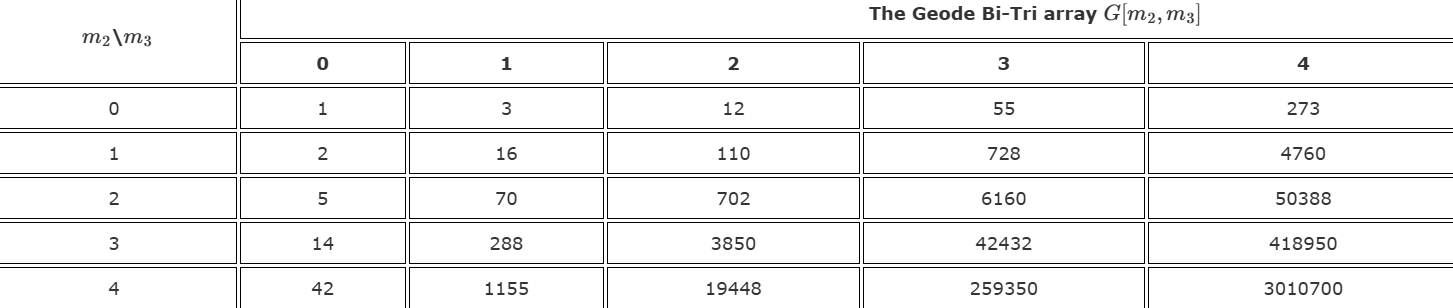
Catalan and Fuss numbers appear down the first column and row, but the rest is an enigma — we can’t find any further connections with the OEIS. Nevertheless, we offer up some intriguing conjectures on the Geode array that might help with further investigations. But it is clear that there is a lot more to study.

At least now undergraduates have a clear cut alternative to the usual Galois theory courses that treat this classic problem in algebra. Both Euler and Lagrange would, we hope, be approving.

My talk with Daniel Rubin on Real Numbers and the Infinite in Analysis

A few days ago I had an online conversation with Dr Daniel Rubin who is a mathematician living in the US and who works in analysis, geometry and approximation theory. The topic was one close to my heart: Daniel wanted to hear of my objections to the status quo concerning the foundations of modern analysis: namely my rejection of “real number arithmetic” and why I don’t accept “completed infinite processes”. And naturally he wanted to do his best to rebut them.

Here is a link to our chat:

It is certainly encouraging to see that some analysts are willing to engage with the uncomfortable idea that their discipline might actually be in serious logical difficulties. Most of us are reluctant to accept that something we have been working on for years and years might actually be wrong. I applaud Daniel for the courage to engage with these important ideas, and to consider how they fit, or don’t fit, into his current view on analysis.

When we learn pure mathematics, there are many things that we at first don’t understand, perhaps because they are obscure, or perhaps because we are not smart enough — it is easy not to be sure which. Our usual reaction to that is: let me try to accept the things which are cloudy, and hopefully with further learning things will become clearer. This is a reasonable approach to tackling such a difficult subject. However it does require us to put aside our natural skepticism, and accept what the more established figures are telling us at critical points in the theoretical development, even if we imagine this is only temporary.

A good example is: “analysis is built from axiomatic set theory.” In other words the foundations of “infinite sets” and so the basic logical structure of the “arithmetic of real numbers” is a consequence of work of logicians, and can be taken for granted without much further inquiry. Or to put it less politely: it is not the job of an analyst to work out clearly the foundations of the subject; this is something that can be outsourced.

In this fashion dubious logical sleights of hand can creep into an area, transmitted from generation to generation and strengthened with each repeat. Young academics in pure mathematics are under a lot of pressure to publish to obtain a foothold in the academic ladder. This means they do not often have time to mull over those knotty foundational questions that might have been bugging them secretly at the backs of their minds. They probably don’t spend a lot of time on the history of these problems, many of which go back centuries, and in former times engaged the interest of many prominent mathematicians.

Later in their career, if our young PhD has been lucky enough to score an academic job, they might be in a position to go back over these core problems and think them through more carefully. But even then there is often not a lot of “academic reward” in doing so: their fellows are not particularly interested in endeavors that are critical of the orthodoxy — pure mathematics is quite different in this regard than science or even applied mathematics!

And journals are uniformly not keen on publishing papers on foundational issues, especially ones which challenge accepted beliefs. As pure mathematics rests on a premise of logical correctness, any questioning of that is seen as subversive to the entire discipline.

But maybe some serious consideration and debate of the underlying logical structure is just what the discipline really needs.

I certainly enjoyed our conversation and I think there are valuable points in it. I hope you enjoy it, and look forward to another public YouTube discussion with Daniel.

The infinitely real delusion, and my recent debate with James Franklin

In the last fifteen years or so, I have become increasingly disenchanted with the way modern mathematics deals with, or rather doesn’t deal with, the serious logical problems which beset the subject. These difficulties arise from a misunderstanding of the nature of `infinite sets’ and `the continuum’, and then extend further in many directions.

`Infinite sets’ are propped up, according to the standard dogma, by certain axiomatics, which lift the burden of having to actually define properly what we are talking about, and prove the various theorems that we would like to have true. What a joke these ZFC axiomatics are. The entire situation is ironic to the extreme: in fact Cantor’s Set Theory was vigorously opposed by most prominent mathematicians during his day, and then collapsed in a catastrophic heap at the beginning of the 20th century due to the discovery of irrefutable paradoxes. And now, fast forward a hundred years later: not only has Set Theory been resurrected, essentially with no new ideas—most of the key concepts go back to Cantor or Turing, and are just endlessly recycled—but now most of us believe that this befuddled and imprecisely laid out subject is actually the correct foundation for the rest of mathematics! This is little short of incredible. I feel I have woken from a dream, while most of my colleagues are still blissfully dozing.

And our notion of the continuum is currently modelled by the so-called ‘real numbers’, which in fact are far removed from most sensible people’s notions of reality. These phoney real numbers that most of my colleagues pretend to deal with on a daily basis are in fact hazy and undefined creations that frolic and shimmer in a fantasy underworld deep beneath the computational precisions of our computers, ready to alleviate us from the dull chore of striving for precise computations, and incorporating correct error bounds when we can obtain only approximations.

We are talking about irrational numbers here; numbers whose names even lay people are familiar with, such as sqrt(2), and pi, and Euler’s number e.

Supposedly there are myriads of other ones, given by various arcane procedures, formulas and properties. The actual theory and arithmetic of such real numbers is never laid out completely correctly; rather we find brief ‘summaries’ of the wished-for properties that these creatures have, properties that ensure that theoretically many standard computational problems have solutions, even if our computers can in fact not find them.

Ask a modern pure mathematician to make the computation pi+e for you, and see what kind of bemused look you get. Is not the answer the same as the question? Is this not how we all do `real number arithmetic’??

The belief in `real numbers’ supports a false mathematical dream-world where almost everything has a solution; a Polyanna fantasy land which can be conjured up by words but not written down on paper. (Of course the computer scientist or applied mathematician or scientist knows that in reality all meaningful computations occur with rational numbers or floating point decimals).

What a boon it is to live in the `infinitely real’ dreamscape of the modern pure mathematician! To conjure up `constructions’ and ` computations’ these days we need only scribble words, phrases and descriptions together. This is why so many of the ‘best’ journals are filled with page after page of what might be generously called `mathematical prose’. See my submission `Let H be a load of hogwash’ to get a feeling for this language of modern mathematics that the journals encourage.

Most pure mathematicians feel little obligation to address the claims of logical weakness. Objections such as mine may be safely ignored. Unlike scientists, we don’t feel the obligation to step up to the plate and respond rationally to criticism, as it clearly cannot be correct: since the majority rules! As long as we all play along, and ignore the increasingly obvious gaps between what our computers can do and what we are claiming, everyone can pretend that things are merry.

But could the tide be turning? A little while ago, James Franklin and I had a public debate (quite civilized and friendly I would add) in the Pure Maths Seminar in the School of Mathematics and Statistics UNSW, and lo and behold– the room was filled to capacity, people were huddled at the doors from outside trying to hear what was said, and my heresies were not met with a barrage of hoots, tomatoes and derision.

Judging from the many comments, it is no longer such a one-sided debate as it was a few decades ago. I reckon that young people’s comfort and trust in computers has a lot to do with it. What is it really, if you can’t get your computer to model it?? Only a fantasy.

You can join the revolution, too. Don’t be so accepting of everything you are told. Ask for explicit examples and concrete computations. Be suspicious of appeals to authority, or the well worn method of swamping with jargon. And of course, watch as many of my videos as you can, for a slow but steady introduction to: a more sensible world of pure mathematics.

Perhaps the forces of confusion and orthodoxy will soon be on the back foot.