This is an important topic on which I will have a lot to say. Today, let’s just gently introduce a big stumbling block for modern analysis.
There are several approaches to the current theory of “real numbers”. Unfortunately, none of them makes sense. One hundred years ago, there was vigorous discussion about the difficulties, ambiguities and even paradoxes. The topic was intimately linked with Cantor’s theory of “infinite sets”.
As time went by, the debate subsided, but the difficulties didn’t really go away. A largely unquestioning uniformity has settled on the mathematics community, with most students now only dimly aware of the logical problems with “uncomputable numbers”, “non-measurable functions”, the “Axiom of choice”, hierarchies of “cardinals and ordinals”, and various anomalies and paradoxes that supposedly arise in topology, set theory and measure theory.
A hundred years ago, the notion of the “continuum” appeared intuitively straightforward, but it was difficult to pin down precisely. The Greeks had struggled with irrational numbers, but the decimal number approach of Simon Stevin in the 16th century seemed reasonable, especially considering that in practice the further digits beyond the three dots in pi=3.14159263… are hardly of practical significance. Great mathematicians like Newton, Euler, Gauss, Lagrange and others were always interested in a combination of applied questions (physics and astronomy mostly) along with more theoretical questions. In the later part of the nineteenth century an increasing preoccupation with trying to pin down the fundamentals of analysis led to both more careful definitions but also to the realization that the default view of irrational numbers as infinite decimals was shaky.
However with the advent of relativity theory and quantum mechanics, the concept of the continuum again became murky: if time is relative and perhaps finite in extent, and space has an inherent graininess which is not infinitely divisible, then what exactly are we modelling with our notion of the `infinite number line’?
While engineers and scientists viewed real numbers primarily as “decimals which go on till we don’t care anymore”, nineteenth century mathematicians introduced the ideas of “equivalence classes of Cauchy sequences of rational numbers”, or as “Dedekind cuts”, or sometimes as “continued fractions”. Each view has different difficulties, but always there is the crucial problem of discussing `infinite objects’ without sufficient regard to how to specify them.
The twentieth century saw an entirely new sleight-of-hand; the introduction of “axiomatics” removed the time-honoured obligation of defining mathematical objects before using them. This was a particularly unfortunate and wrong-headed turn of events that has done much to diminish the respect for rigour in modern mathematics.
A finite sequence such as S=1,1,2,5,14,42,132,429,1430 may be described in many different ways, but ultimately there is only one way to specify such a sequence S completely and unambiguously: by explicitly listing all its elements.
When we make the jump to infinite sequences, such as the sequence of Catalan numbers C=1,1,2,5,14,42,132,429,1430… (sequence A000108 in Sloane’s Online Encyclopedia of Integer Sequences (OEIS) at http://oeis.org/ ) the situation changes dramatically. It is never possible to explicitly list “all” the elements of such a “sequence”; indeed it is not clear what the word “all” even means, and in fact it is not clear even what the term “infinite sequence” precisely means. (Do you think you have a good definition?)
But assuming for a moment that we have some idea of the terms involved: still we are obliged to admit that in the absence of a complete list of the elements, we can specify the Catalan sequence C essentially only by giving a rule which generates it. A quick look at Sloane’s entry for the Catalan numbers shows some obvious problems: which of the potentially many rules that generate the Catalan numbers are we going to use? How are we going to tell when one rule actually agrees with a seemingly quite different one? Is there some kind of theory of `rules’ that we can apply to give meaning to the generators of a sequence?
If we think in terms of computation, an infinite sequence can also be modelled by a computer program, churning out number after number onto a long tape (or these days your hard drive). At any given point in time, there are only finite many outputs. As long as you keep supplying more tape, electricity, and occasionally additional memory banks, the process continues. The sequence is not to be identified by the `completed output tape’, which is a figment of our imagination, but rather by the computer program that generates it, which is concrete and completely specifiable. However here we come to the same essential difficulty with infinite processes: the program that generates a given infinite sequence is never unique. There is no escape from this inescapable fact, and it colours all meaningful aspects of dealing with `infinity’. It seems that any proper theory of real numbers presupposes some kind of prior theory of algorithms; what they are, how to specify them, how to tell when two of them are the same.
Unfortunately there is no such theory.
With sets the dichotomy between finite and `infinite’ is much more severe than for sequences, because we do not allow a steady exhibition of the elements through time. It is impossible to exhibit all of the elements of an `infinite set’ at once, so the notion is an ideal one that more properly belongs to philosophy—it can only be approximated within mathematics. The notion of a `completed infinite set’ is contrary to classical thinking; since we can’t actually collect together more than a finite number of elements as a completed totality, why pretend that we can? It is the same reason that `God’ or `the hereafter’ are not generally recognized as proper scientific entities. Both infinite sets, God and the hereafter may very well exist in our universe, but this is a philosophical or religious inquiry, not a mathematical or scientific one.
The idea of `infinity’ as an unattainable ideal that can only be approached by an endless sequence of better and better finite approximations is both humble and ancient, and one I would strongly advocate to those wishing to understand mathematics more deeply. This is the position that Archimedes, Newton, Euler and Gauss would have taken, and it is a view that ought to be seriously reconsidered.
Why is any of this important? The real numbers are where Cantor’s hierarchies of infinities begins, and much of modern set theory rests, so this is an issue with widespread consequences, even within algebra and combinatorics. Secondly the real numbers are the arena where calculus and analysis is developed, so difficulties lead to weakness in the calculus curriculum, confusion with aspects of measure theory, functional analysis and other advanced subjects, and are obstacles in our attempts to understand physics. In my opinion, we need to understand mathematics in the right way before we will be able to unlock the deepest secrets of the universe.
By reorganizing our subject to be more careful and logical, and by removing dubious `axiomatic assumptions’ and unnecessary philosophizing about `infinite sets’, we make it easier for young people to learn, appreciate and contribute. This also strengthens the relationship between mathematics and computing. It is time to acknowledge the orthodoxy that silently frames our discipline. We need to learn from our colleagues in physics and computer science, and begin the slow, challenging but ultimately rewarding task of restructuring mathematics properly.


 And I suppose I better show you a mountain, of which there are many around, but sadly the weather has not been entirely cooperative for sunny photos. This taken from the train on the way to Graz from Innsbruck.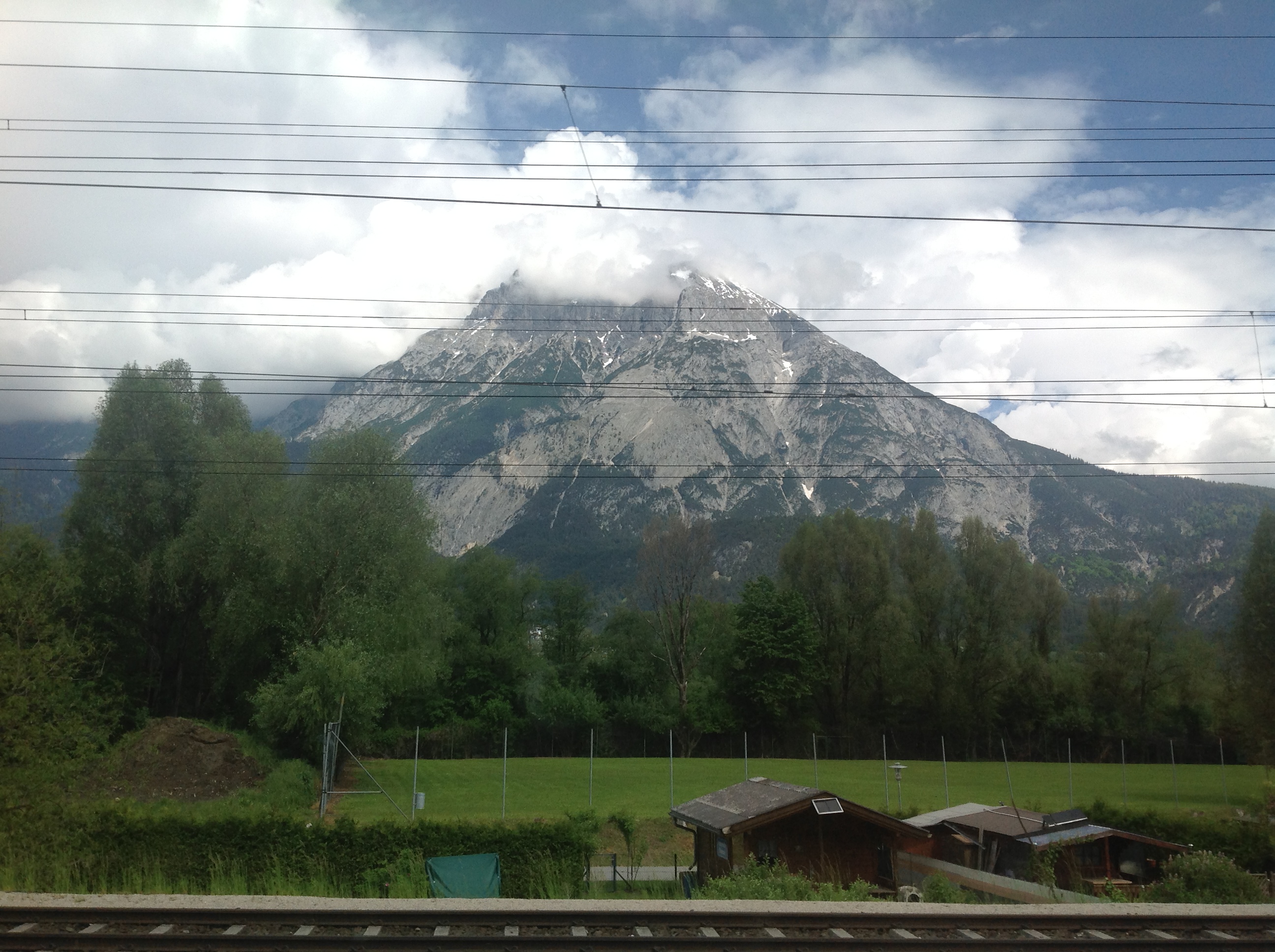
 njwildberger: tangential thoughts